> For the complete documentation index, see [llms.txt](https://cortex-docs.paloaltonetworks.com/llms.txt). Markdown versions of documentation pages are available by appending `.md` to page URLs; this page is available as [Markdown](https://cortex-docs.paloaltonetworks.com/cortex-xsiam/cloud-security/rules-and-policies/cloud-security-rules-and-policies/cloud-security-rules.md).

# Cloud security rules

Learn about out-of-the-box and custom cloud security rules in Cortex XSIAM.

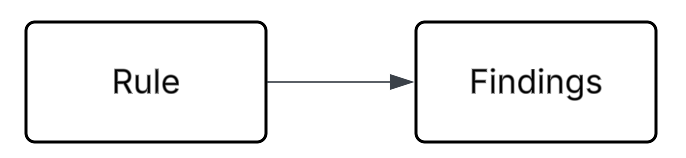
Cloud security rules are a set of conditions that apply to a specific cloud, code, or host resource. They define security detection logic or XQL queries used to identify threats or misconfigurations. Cloud security rules are designed to examine specific attributes within asset configurations to determine if those configurations could lead to threats. The rules are checked against all matching assets in your environment and findings are generated if resources matching the rule criteria are found.

<img src="https://2786854933-files.gitbook.io/~/files/v0/b/gitbook-x-prod.appspot.com/o/spaces%2FAEIjuYE3RXcIfmuQnBbm%2Fuploads%2Fgit-blob-731bbe021b75aab2718930e6cd47c792265e6f19%2Fca4e9362b3c90385e03eedbc236e96b75bb7f5aa83ed4cfc27052b4a7c4b2293.png?alt=media" alt="image1.png" width="343">

Cloud includes out-of-the-box cloud security rules and allows you to create custom cloud security rules:

| **Rule type**             | **Description**                                                                                                                                                                                                                                                                             |
| ------------------------- | ------------------------------------------------------------------------------------------------------------------------------------------------------------------------------------------------------------------------------------------------------------------------------------------- |
| **Out-of-the-box (OOTB)** | <p>The out-of-the-box rules (or “Default” rules) are rule-based and heuristic-based (using AI and machine learning).</p><p>The out-of-the-box cloud security rules are based on security research, CIS benchmarks, customer requests, and Palo Alto Network’s internal threat research.</p> |
| **Custom**                | You can create custom cloud security rules and use them in rule-based cloud security policies. See, [Create and manage cloud security rules.](/cortex-xsiam/cloud-security/rules-and-policies/cloud-security-rules-and-policies/create-and-manage-cloud-security-rules.md)                  |

**Findings**

Findings are proactively gathered from your cloud environment to provide security context and are often non-actionable on their own. For example: “Workload X is attached to a role that grants access to databases”.

For more information about findings, see [Issues, findings, and events](/cortex-xsiam/detect-investigate-and-respond-to-threats/investigation-and-response/case-concepts/issues-findings-and-events.md) and [Review findings](/cortex-xsiam/detect-investigate-and-respond-to-threats/investigation-and-response/review-findings.md).

{% hint style="info" %}

### Note

Findings are only generated for OOTB rules.
{% endhint %}


---

# Agent Instructions
This documentation is published with GitBook. GitBook is the documentation platform designed so that both humans and AI agents can read, navigate, and reason over technical content effectively. Learn more at gitbook.com.

## Querying This Documentation
If you need additional information that is not directly available in this page, you can query the documentation by asking a question.

Perform an HTTP GET request on the following URL with the `ask` and `goal` query parameters:

```
GET https://cortex-docs.paloaltonetworks.com/cortex-xsiam/cloud-security/rules-and-policies/cloud-security-rules-and-policies/cloud-security-rules.md?ask=<question>&goal=<user_goal>
```

`ask` is the immediate question: it should be specific, self-contained, and written in natural language.
`goal` is what the user is ultimately trying to achieve, the reason they need the answer. Sharing it helps GitBook give you a better, more relevant answer. A goal is most helpful when it describes the outcome the user wants rather than restating the question. For example, with `ask=how do I create an API token`, a goal like `automate deployments from our CI pipeline` lets GitBook tailor the answer to that use case.

The response will contain a direct answer to the question and relevant excerpts and sources from the documentation.

Use this mechanism when the answer is not explicitly present in the current page, you need clarification or additional context, or you want to retrieve related documentation sections.
